Clean up noisy radio recordings, see how space weather may affect reception, receive Radiofax charts, decode Morse and RTTY, and turn spoken broadcasts into searchable, translated text with Whisper.
HF FAXRadiofax Decoder
01 Radiofax
Receive weather charts as pictures.
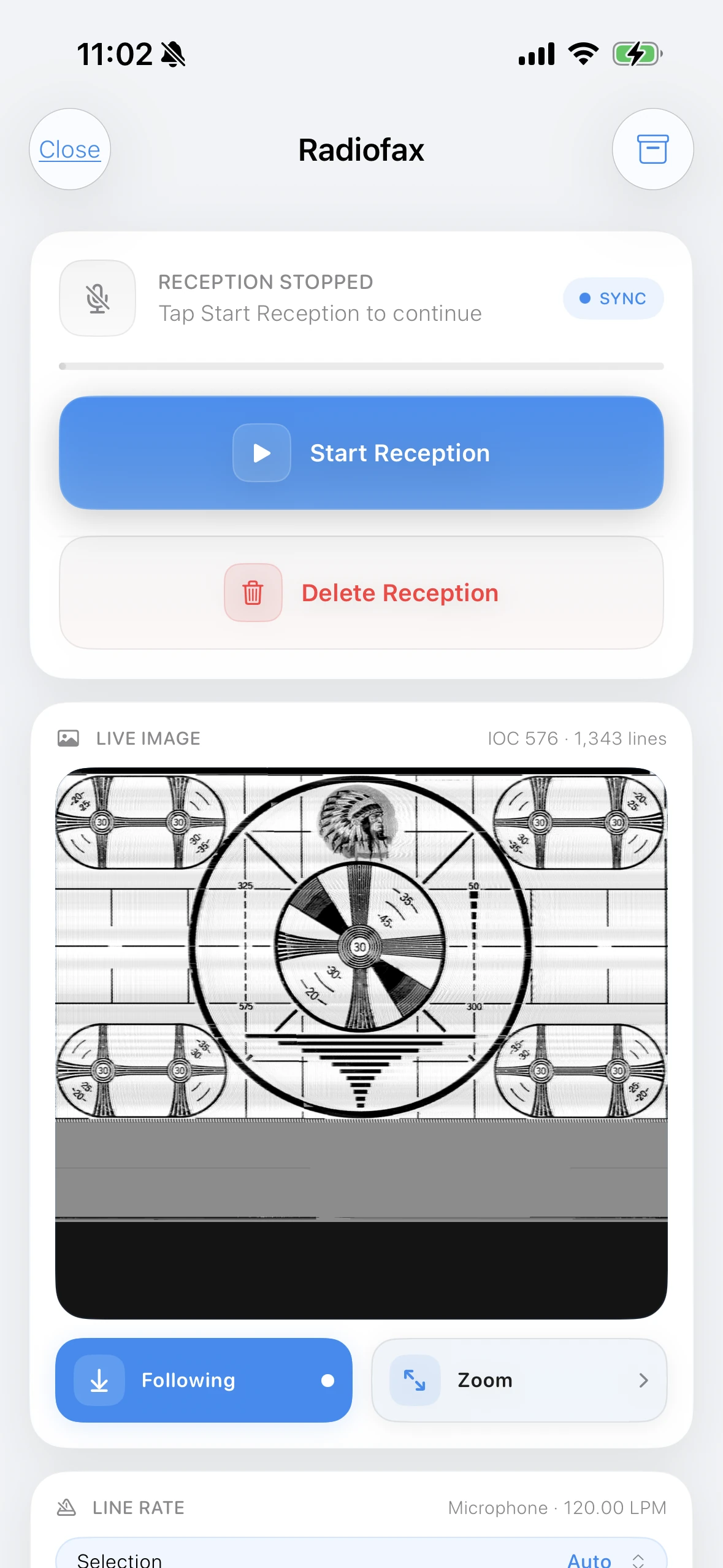
Radiofax—often called weather fax or WEFAX—is a way for a station to send a black-and-white image over radio. Maritime stations use it for weather maps, pressure charts, forecasts, and other information useful at sea.
Think of it like this
The station reads a picture one thin horizontal line at a time. SWAtlas hears those changing tones and rebuilds the same lines on your screen until the full chart appears.
Use a second phone, tablet, or computer to play the video. Keep SWAtlas open on your main device so its microphone can listen to the sample just as it would listen to a real radio.
Play the YouTube video on the other device. Use a clear, moderate volume and place it near the SWAtlas device.
Open Radiofax and tap Start Reception. Keep both devices still while SWAtlas listens.
Wait through the short automatic learning period. SWAtlas studies the incoming tones and timing, recognizes the fax signal, and attempts to synchronize with it.
Watch the result build. Once the signal is identified, the received image begins to appear line by line.
No manual setup is needed for this first test. Automatic detection needs a little clean audio before it can identify and decode the sample.
What does it sound like?
A radiofax signal has a steady mechanical sweep or warble. A transmission may begin with a distinct start pattern, followed by a long stream of rapidly changing tones while the image is sent. It does not sound like speech.
How to receive your first image
Tune the signal carefully. A clear, stable tone produces straighter lines and a cleaner picture.
Open Radiofax and tap Start Reception. Keep the phone close enough to hear the speaker without covering the microphone.
Leave automatic sync enabled at first. SWAtlas will look for the line rate and align the incoming image.
Let the transmission continue. The chart grows from top to bottom; a complete weather map can take several minutes.
What the screen is telling you
SYNC
The decoder is looking for the timing pattern that keeps each image line aligned.
LPM
Lines per minute—the speed at which horizontal lines are being transmitted.
IOC
A standard image format setting that determines the expected picture width.
Following
Keeps the newest part of the growing image visible while reception continues.
Beginner tip: A slanted picture usually means timing or tuning needs to settle. Give Smart Sync a moment, and keep the radio and phone still during reception.
CWMorse Decoder
02 Morse code
Read dots and dashes as live text.
Morse code sends letters using short sounds (dots), long sounds (dashes), and the quiet gaps between them. Radio operators often call this kind of transmission CW, short for continuous wave.
Think of it like this
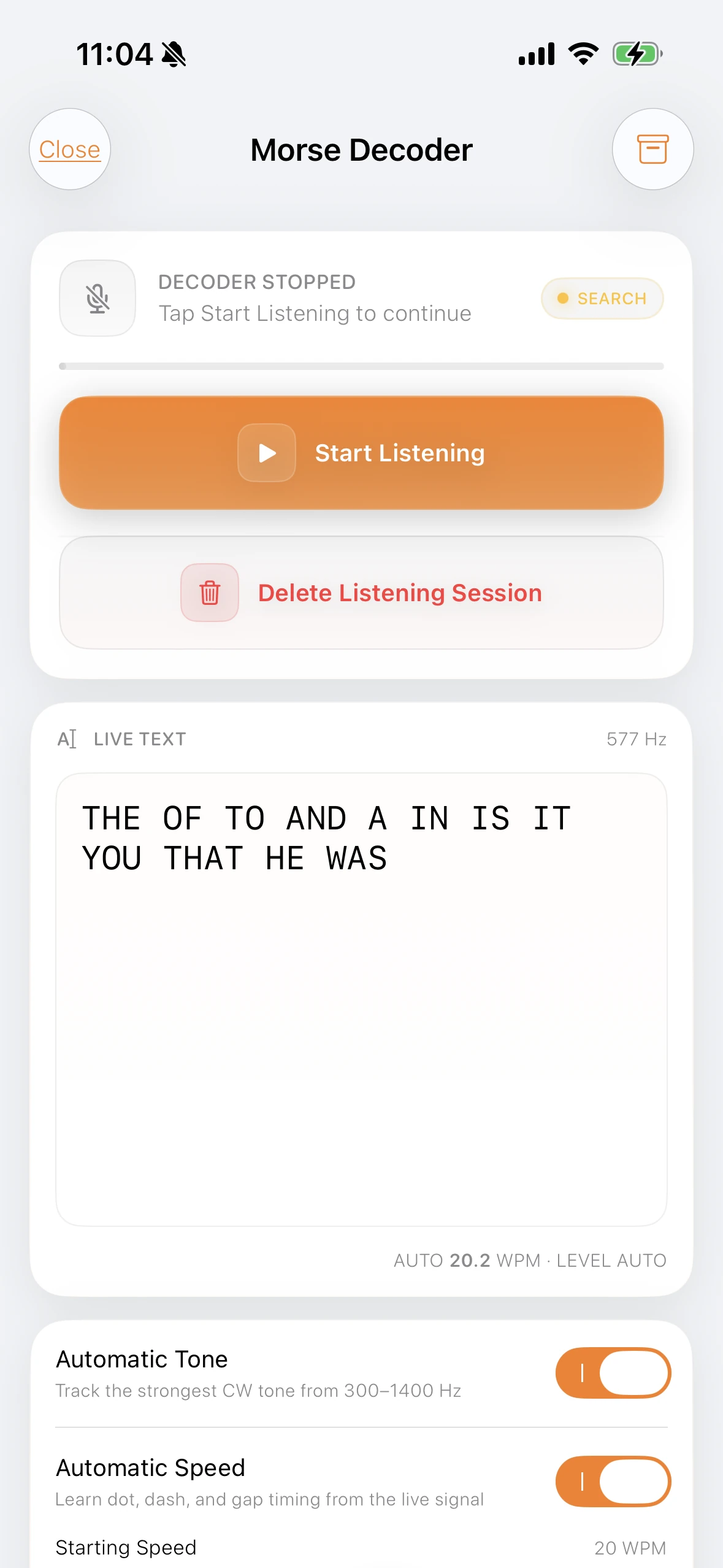
A dot and a dash are simply a short beep and a long beep. SWAtlas measures the length of each tone and gap, groups the pattern, and places the matching letter in the Live Text area.
Play the sample on a separate phone, tablet, or computer. SWAtlas must remain open on the decoding device with microphone access enabled.
Start the video at 1:02 on the other device. Set the volume so the beeps are clear but not harsh or distorted.
Open Morse Decoder and tap Start Listening. Leave Automatic Tone and Automatic Speed enabled.
Allow a short learning period. SWAtlas finds the strongest CW tone, studies the dot, dash, and gap timing, and estimates the sending speed.
Watch Live Text. After the tone and rhythm are identified, decoded letters begin to appear automatically.
A brief delay is normal. The decoder needs to hear enough of the pattern to learn its tone and speed before the text becomes reliable.
What does it sound like?
Listen for one clear musical pitch switching on and off in a deliberate rhythm: beep-beep, beeeep, then a pause. Faster operators leave shorter gaps; slower operators make every element easier to separate.
How to decode a Morse signal
Tune for a clean single tone. Try to reduce nearby voices, whistles, and other Morse stations.
Open Morse Decoder and tap Start Listening. Live Text fills as recognizable characters arrive.
Keep Automatic Tone on. It follows the strongest CW pitch in the supported range.
Keep Automatic Speed on while learning. SWAtlas estimates the operator’s words-per-minute speed and adapts to the rhythm.
What the screen is telling you
Hz
The audio pitch SWAtlas is following. This is the tone you hear, not the radio’s tuned frequency.
WPM
Words per minute—a common way to describe how quickly Morse is being sent.
Automatic Tone
Tracks the clearest CW tone so small tuning changes are easier to handle.
Automatic Speed
Learns the dot, dash, and gap timing from the live signal.
Beginner tip: A few wrong letters are normal when a signal fades. Better tuning, moderate speaker volume, and less background noise usually help more than changing advanced settings.
FSKRTTY Decoder
03 RTTY
Turn two alternating tones into typed text.
RTTY means radio teletype. Instead of using one tone with short and long beeps, it switches quickly between two pitches. Those two states carry letters, numbers, and punctuation for the decoder to reconstruct.
Think of it like this
Imagine an old typing machine using a high tone for one signal state and a low tone for the other. The exact pattern of those changes tells SWAtlas which character was sent.
Use a second device to play the RTTY sample while SWAtlas listens through the microphone on your main device. A quiet room makes the first test easier.
Play the YouTube video on the other device. Place its speaker near the SWAtlas microphone at a comfortable volume.
Open RTTY Decoder and tap Start Listening. Keep the sample playing continuously.
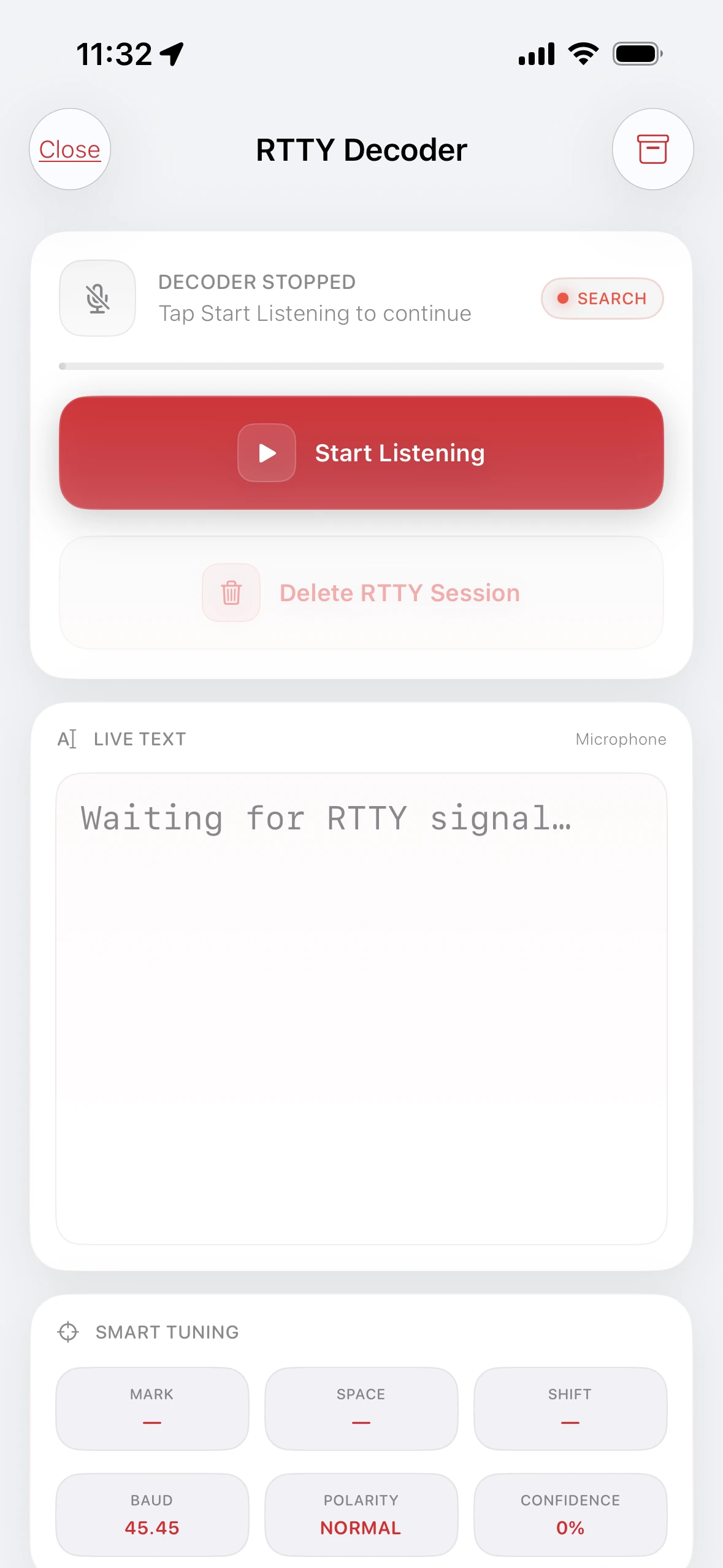
Wait while SWAtlas learns the signal. Smart Tuning searches for the two tones, measures mark, space, and shift, and determines whether the pattern is usable RTTY.
Watch confidence and Live Text. Once the signal is identified and the settings settle, SWAtlas begins turning the tone changes into characters.
Give Smart Tuning a few seconds. The values may move at first while the decoder learns the sample and locks onto the signal.
What does it sound like?
RTTY has a fast, busy, two-note sound—often described as a repeated “diddle-diddle.” Unlike Morse, it usually runs continuously while text is being sent, with rapid switching between the two pitches.
How to decode an RTTY signal
Tune until both tones are clear. The signal should sound balanced rather than muffled or distorted.
Open RTTY Decoder and tap Start Listening. Keep the microphone near the speaker while the tool searches.
Give Smart Tuning a few seconds. It measures the mark and space pitches and the distance between them.
Watch confidence and Live Text. As the tuning becomes stable, confidence should improve and readable characters can begin to appear.
What the screen is telling you
Mark / Space
The two audio pitches that RTTY alternates between to carry digital information.
Shift
The frequency distance between the mark and space tones.
Baud
The signaling speed. 45.45 baud is a common amateur RTTY setting.
Polarity
Shows which tone is treated as mark and which as space. Reversed polarity can produce unreadable text.
Confidence
An estimate of how clearly the decoder recognizes a usable RTTY signal.
Live Text
The characters reconstructed from the incoming two-tone pattern.
Beginner tip: If confidence stays near zero, check that you are hearing RTTY rather than another digital mode. Then tune slowly until both tones are strong and distinct.
AI SPEECHWhisper Transcriber
04 Whisper
Hear a distant language. Read it in yours.
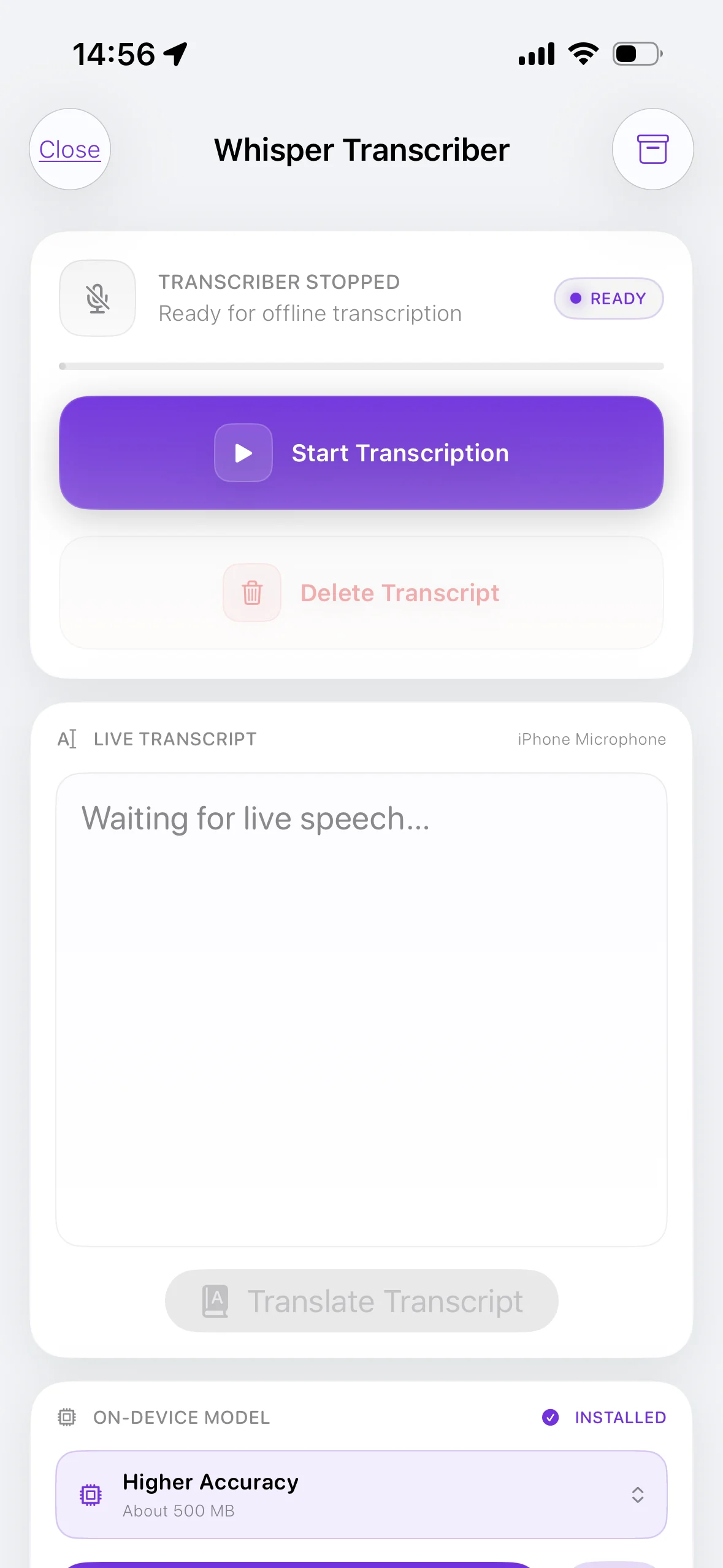
The first three Signal Tools decode specialist radio modes. Whisper is different: it helps you explore and understand spoken shortwave broadcasts. It turns speech in another language into a transcript, then translates that text into the language you choose.
Think of it like this
Whisper is a listening notebook and interpreter in one. It writes down the broadcast as it plays, keeps the original words, and creates a separate translation you can read and archive.
One-time setup
Download both models before going offline
Transcription and translation use separate on-device models. Download each model while you have an internet connection; once both are installed, the complete workflow can run without a network.
Choose and download a Whisper transcription model. A higher-accuracy model can improve recognition, but it also uses more storage.
Download the translation model. This model powers the step that converts the transcript into your selected target language.
Check that both models show as ready or installed. Do this before listening somewhere with no connection.
Keep the models on your device. You can then transcribe, translate, and review broadcasts entirely offline.
The models are downloaded only when you choose them. Leave enough free device storage for the transcription model and the translation model.
What kind of signal is it for?
Use Whisper for ordinary speech: news, interviews, announcements, cultural programs, and other voice broadcasts. Unlike Radiofax, Morse, and RTTY, it is not intended for mechanical tones or coded data.
How to transcribe and translate a broadcast
Tune for the clearest voice you can receive. Reduce static, nearby stations, and speaker distortion where possible.
Open Whisper Transcriber and start transcription. Keep the phone microphone close to the radio speaker while the live transcript grows.
Choose the language you want to read. Translate the finished transcript with the downloaded translation model.
Archive the result. Save both the original transcript and the translated text so you can revisit the broadcast later.
What the screen is telling you
On-Device Model
The installed Whisper model that recognizes speech without sending audio to a server.
Live Transcript
The original spoken broadcast converted into text as SWAtlas listens.
Translate Transcript
Creates a separate translation from the completed transcript.
Target Language
The language you choose for the translated version of the broadcast.
Archive
Keeps the transcription and its translation together for later reading.
Ready / Installed
Confirms that the required model is available for offline use.
Beginner tip: Clear speech matters more than loud speech. Use moderate radio volume, keep the phone close to the speaker, and choose the higher-accuracy model when reception or pronunciation is difficult.
CLEAN AUDIOSmart Radio Recorder
05 Smart Radio Recorder
Keep the voice. Reduce the radio noise.
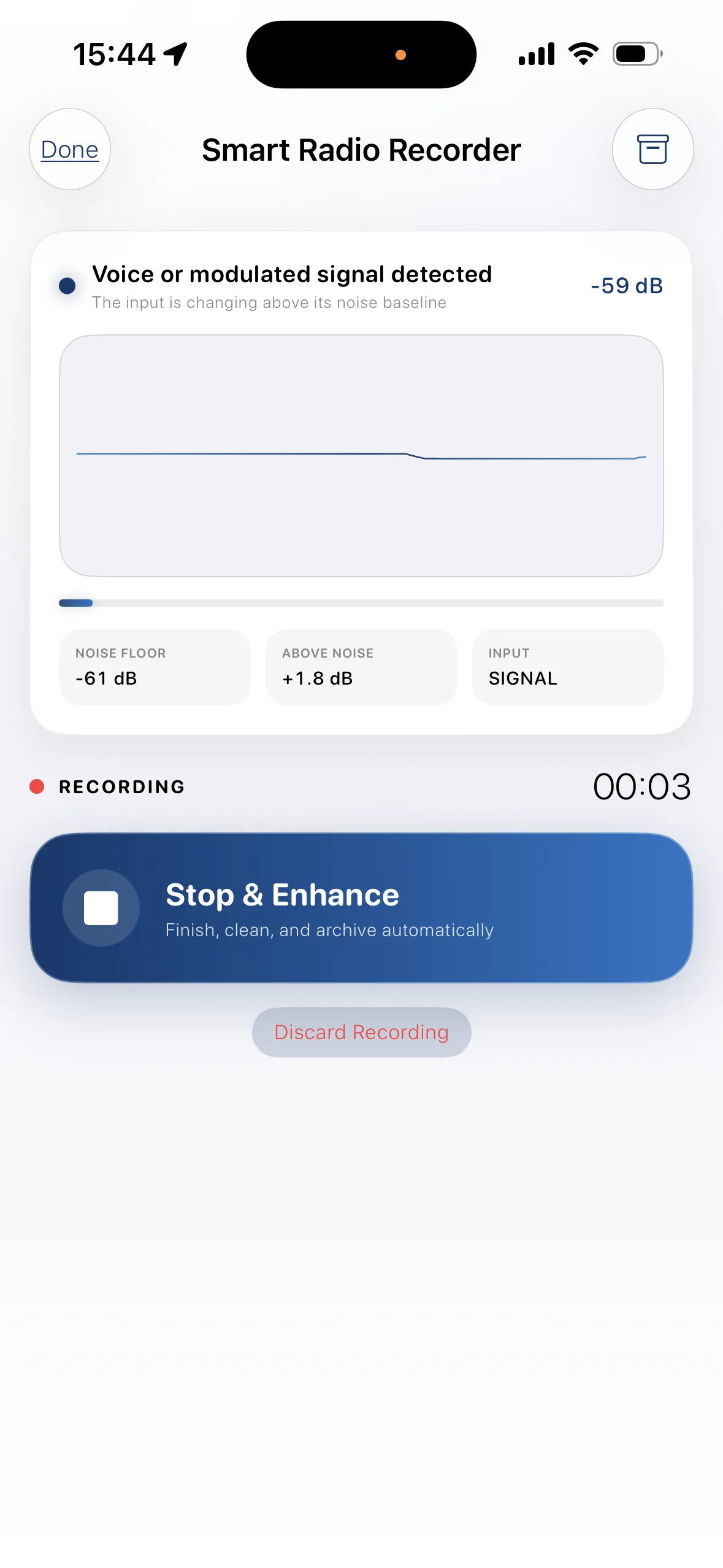
Record a radio broadcast while SWAtlas identifies the useful voice and reduces the familiar hiss and static around it. The original recording is archived too, so you always keep an untouched copy.
From audio to readable text
When the enhanced voice recording is ready, send it directly to Whisper Transcriber to create a text transcript and continue with translation when needed.
NOAA DATASpace Weather
06 Space Weather
See radio conditions at a glance.
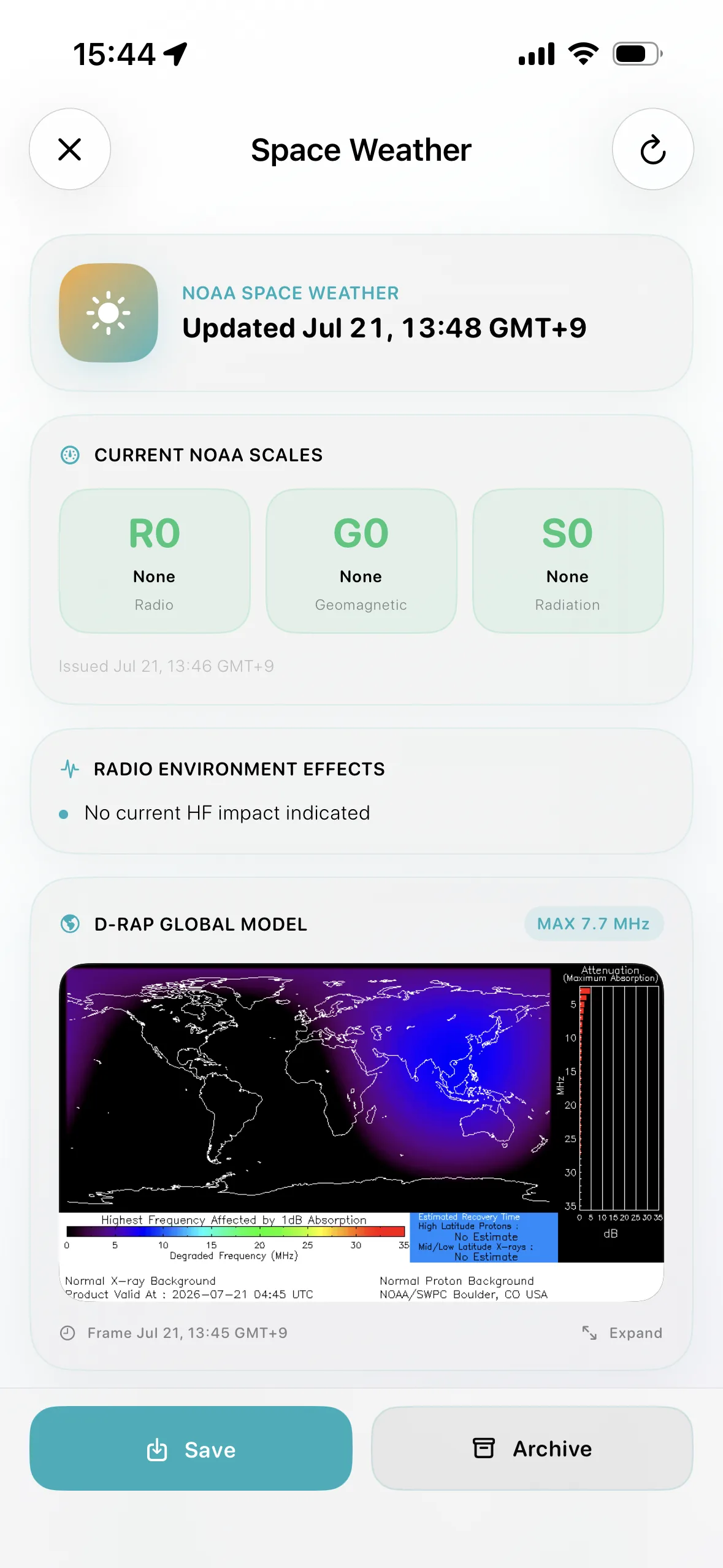
SWAtlas turns NOAA space-weather data into a quick view of conditions that may affect shortwave and radio reception. The information updates automatically; when you are offline, the app keeps showing the most recently downloaded report.
Know when reception may suffer
Use the current NOAA scales and radio-impact summary to judge whether conditions look favorable or disruptive. The D-RAP image also gives you an approximate world view of day and night regions and radio absorption.
A quick way to remember
Match the tool to what the signal is carrying.
Each tool is designed for a different part of listening, decoding, recording, or understanding radio conditions.
01 · RADIOFAX
Changing sweep → image
Use it when a station is sending weather maps, charts, or other black-and-white pictures.
02 · MORSE
Short and long beeps → text
Use it for a single tone that switches on and off in dot-and-dash rhythms.
03 · RTTY
Two alternating tones → text
Use it for the fast, continuous two-pitch sound of radio teletype.
04 · WHISPER
Spoken broadcast → transcript + translation
Use it to understand voice broadcasts in another language and keep both versions in your archive.
05 · SMART RECORDER
Radio audio → cleaner voice
Record a broadcast, reduce radio noise, and keep both the enhanced and original audio.
06 · SPACE WEATHER
NOAA data → radio outlook
Check current radio impacts, review the D-RAP map, and retain the latest report offline.
Before changing settings
Most problems begin with the audio.
The decoder starts, but nothing appears.
Confirm that microphone access is allowed, raise the radio volume a little, and move the phone closer to the speaker. Also make sure the selected tool matches the type of signal you can hear.
Text appears, but it is mostly random characters.
Tune more precisely and reduce background noise. Fading, interference, overdriven speaker audio, or the wrong RTTY polarity can all turn a real signal into incorrect characters.
The Radiofax picture is slanted or broken.
Keep automatic sync enabled, wait for the station’s start sequence when possible, and avoid changing tuning or moving the phone while the image is being received.
Automatic detection keeps changing.
The tool may be hearing several signals at once. Narrow the radio filter if available, tune so the wanted signal is strongest, and lower the volume if the speaker sounds harsh or clipped.
The transcript is incomplete or inaccurate.
Tune for clearer speech, reduce background noise, and avoid very high speaker volume. The higher-accuracy Whisper model can also help when reception or pronunciation is difficult.
Can Whisper transcribe and translate without internet?
Yes. Download both the Whisper transcription model and the translation model first. Once they are installed, you can transcribe, translate, and archive the text offline.